Rail freight is one of the key methods for transporting goods, especially over long distances. When considering transit routes through Belarus or Russia, this logistical alternative has certain advantages but also significant risks and challenges — both technical and geopolitical. For example, the recent closure of the Poland–Belarus border affected rail freight transit. This article provides an overview of the main pros and cons of such routes, along with practical recommendations for companies considering rail transport through these countries.
One form for any questions
Fill in the fields below, and we’ll take care of the rest. Our expert will contact you!
Thank you for your request!
Your request has been successfully teleported to our processing center!Stay tuned – our manager will contact you shortly!
BACK TO HOME

27 October, 2025
Advantages of rail transport:
1. Relatively faster than sea transport
Compared to maritime shipping, rail can provide significantly faster delivery over long distances — particularly between Asia/China and Europe. This is why such routes are often chosen to save time. For example, when the Belarus route was operating smoothly, it was part of the “rail express” connecting China and Europe.
2. More predictable scheduling than some other transport modes
Compared to ocean freight, rail transport generally experiences fewer delays due to weather or maritime disruptions. For companies where timing and predictability are critical, this is a major advantage.
3. Potential competitive advantage through transit routes
For businesses handling time-sensitive goods or sensitive supply chains, rail can be a better alternative. If the route operates smoothly, it may provide an edge over competitors relying solely on maritime transport.
4. Fewer weight and volume restrictions compared to air transport
While air freight is faster, it is also more expensive and has strict limitations. Rail provides a middle ground: faster than sea, cheaper than air.
Disadvantages and risks of rail transport through Belarus / Russia
1. Geopolitical risks and the possibility of sudden border closures
A key risk is dependence on the political situation. For instance, Poland closed its border with Belarus, including rail freight crossings, due to the Zapad‑2025 military exercises.
- As a result, over 130 freight trains were left “stranded” at Brest (Belarus) due to halted transit to Poland.
- Unexpected border closures lead to delays, additional storage costs, rerouting, and downtime. This reduces predictability for transit through unstable borders.
2. Transit through countries with complex regulatory or logistical environments
Routes through Belarus or Russia may involve more administrative procedures, customs/transit formalities, changes of wagons or track gauges, and certification/document issues. Additionally, sanctions, restrictions, and extra inspections can further complicate the process.
3. Dependence on infrastructure and its condition
Rail routes must be technically suitable: track condition, logistics hubs, rolling stock, and transshipment facilities all affect timing and reliability. Transit through Belarus or Russia may create bottlenecks and delays at borders or transfer points.
4. Higher risk of delays compared to direct routes
Customs/transit procedures, wagon or track changes, and transshipment can increase delivery times. Even a single unexpected border closure can hold up the entire shipment.
5. Cost of risks and unexpected expenses
This includes storage fees, delays, rerouting costs, and potentially using more expensive alternatives. Insurance premiums may also be higher.
6. Less flexibility compared to road transport (in some cases)
For small shipments or deliveries to remote locations, rail may be less flexible, requiring transshipment and road transport to/from stations. In unstable routes, trucks can bypass obstacles more quickly.
Specifics regarding the poland–belarus border closure
- As noted, Poland closed rail and road crossings with Belarus on September 12, 2025, due to Zapad military exercises, affecting rail transit.
- This closure caused major delays: over 130 trains were stuck at Belarusian stations.
- Although the border reopened later in September 2025.
- Companies must be aware that routes through Belarus/Poland carry geopolitical vulnerability — alternative routes or contingency plans are recommended.
Practical recommendations for businesses
- Assess the route with a risk analysis: Consider transit through Belarus/Russia — how stable is it, which borders may close, and what sanctions or restrictions apply.
- Have alternative routes or a backup plan: If a border or transfer station becomes unavailable, plan for a secondary route (e.g., southern routes or sea transport).
- Account for extra time and costs: Plan for possible delays in transit through politically unstable countries.
- Control documentation and customs/transit formalities: Proper paperwork, knowledge of requirements, and border regulations are crucial.
- Coordinate with the carrier and logistics operator: Ensure the operator has experience with such routes, knows the risk zones, and has contingency plans.
- Insure cargo and risks: Invest in insurance covering delays, storage, and rerouting due to unforeseen events.
- Monitor political and border situations: For example, transit through Belarus/Poland depended on Polish government decisions during military exercises.
Rail transport through Belarus or Russia can be advantageous — faster than sea, cheaper than air, with good potential for large-volume transit. However, it is not without risks: key concerns include geopolitical instability, transit through higher-risk countries, and administrative/infrastructure challenges. Companies considering such routes should weigh the benefits against the risks, prepare a contingency plan, and be ready for scenarios in which borders or transit routes may become temporarily unavailable.
Articles that may interest you

Chinese robots are already cheaper than employees: where businesses start saving in 2026.
Just a few years ago, industrial and humanoid robots were considered expensive technologies available only to large multinational corporations. However, by 2026, the situation has changed dramatically.

Importing goods from China without unnecessary hassle: how DM IMPORT handles the entire process.
Importing goods from China opens up significant opportunities for businesses, but at the same time it involves numerous organizational tasks. Finding a manufacturer, verifying suppliers, negotiating terms, arranging payments, organizing logistics, handling customs clearance, and preparing documentation all require time, expertise, and constant supervision.
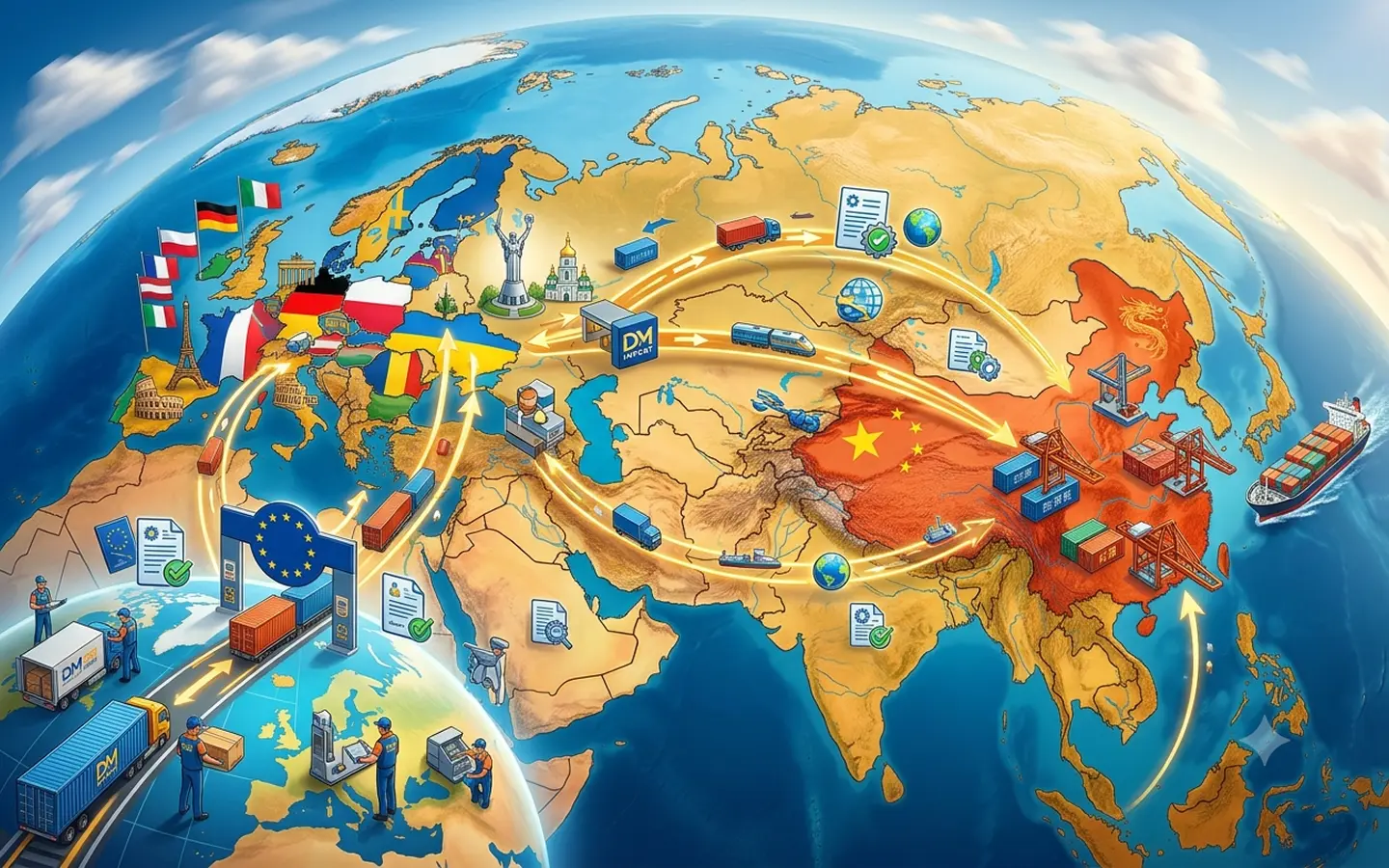
International delivery and customs clearance of goods from China: DM IMPORT works not only with Ukraine but also with EU countries.
Importing goods from China has long become an essential part of international business. Companies search for reliable manufacturers, optimize costs, and expand their sales markets. Today, DM IMPORT supports businesses not only in Ukraine but also across European Union countries, providing comprehensive assistance for international shipments.
TECHNICAL PARTNER

DM Import sincerely thanks KossaSoft company and team for their help in implementing projects. Your support is invaluable, and we are grateful for your contribution to our work.
KossaSoft is an IT company providing development and design services, from mobile applications to full-fledged platforms and CRM systems.
KossaSoft is known for its high-quality project execution, allowing our initiatives to reach new heights. Their team’s solutions and professional approach ensure reliable technical support and top-quality services. Thanks to their expertise, we can offer our users the best product with high quality and stable performance.

Development
Development of custom mobile applications that increase customer engagement.

Web Design
Creation of modern and functional websites that meet all business requirements.

UI/UX Design
User interface design that ensures intuitive and convenient usage.

Support
Providing reliable technical support and maintenance for the uninterrupted operation of your projects.