Modern logistics increasingly deals with goods that may pose potential risks during transportation — batteries, chemical reagents, pharmaceuticals, fuels, paints, solvents, and more. All of these belong to the category of Dangerous Goods. Such cargo requires special transport conditions, packaging, labeling, and accompanying documentation — particularly the MSDS (Material Safety Data Sheet).
One form for any questions
Fill in the fields below, and we’ll take care of the rest. Our expert will contact you!
Thank you for your request!
Your request has been successfully teleported to our processing center!Stay tuned – our manager will contact you shortly!
BACK TO HOME

27 October, 2025


What is dangerous cargo?
Dangerous cargo is any substance or product that, during transportation, can pose a risk to:
- Human life and health,
- The environment,
- The integrity of the vehicle or other goods.
This definition is established by the ADR (European Agreement concerning the International Carriage of Dangerous Goods by Road), as well as IMO (maritime) and IATA (air transport) regulations.
Main classes of dangerous goods
The international classification (UN / ADR) divides dangerous goods into nine classes, depending on the type of risk they pose during transportation:
Class 1 — Explosives.
This class includes items capable of exploding or causing an explosion when exposed to impact or heat. Examples: fireworks, ammunition.
Class 2 — Gases.
These may be compressed, liquefied, or dissolved gases. Examples: propane, butane, oxygen.
Class 3 — Flammable liquids.
Liquids that easily ignite when in contact with an open flame or heat. Examples: gasoline, solvents, alcohols.
Class 4 — Flammable solids.
Materials that can easily catch fire due to friction or heat. Examples: sulfur, sodium, magnesium.
Class 5 — Oxidizing substances.
Materials that release oxygen and can support the combustion of other substances. Examples: nitrates, peroxides.
Class 6 — Toxic and infectious materials.
Substances that are dangerous to human or animal health. Examples: poisons, chemicals, medical samples.
Class 7 — Radioactive materials.
Materials that emit ionizing radiation. Examples: isotopes, medical radiation sources.
Class 8 — Corrosive substances.
Substances that can damage metals, fabrics, skin, or other materials. Examples: acids, alkalis.
Class 9 — Miscellaneous dangerous substances.
This class includes materials that do not fit into previous categories but still pose a risk. Examples: lithium-ion batteries, electronics, environmentally hazardous substances.
Why batteries are considered dangerous cargo?
Batteries — especially lithium-ion ones — fall under Class 9 of dangerous goods. They can overheat, explode, or ignite when mechanically damaged or short-circuited.
Examples of goods considered dangerous due to batteries:
- Smartphones, laptops, drones, e-scooters, power banks, electric vehicles;
- Battery packs and charging stations;
- Spare or replacement batteries.
What is an MSDS? (Material Safety Data Sheet)
An MSDS is a document containing detailed information about the composition, properties, risks, and handling instructions for a hazardous material. It is mandatory for every type of dangerous product — whether transported by sea, air, road, or rail.
- Chemical composition;
- Hazard level;
- ADR class / UN code (e.g., UN3480 – lithium-ion batteries);
- Storage and transport conditions;
- Actions in case of fire or leakage;
- Safety recommendations for personnel.
Without an MSDS, a logistics company or customs authority will not permit the transport of dangerous goods — it serves as the official confirmation of product safety compliance.
How dangerous goods are transported
1. Special packaging
- Packaging must be sealed, impact- and moisture-resistant, and able to withstand drops.
- For batteries — contact points must be insulated to prevent short circuits.
- Each unit must display hazard labels, UN numbers, and warning symbols.
2. Documentation
In addition to the MSDS, the following documents are required:
- Shipper’s declaration for dangerous goods;
- Packing certificate;
- Transport waybill indicating ADR class and UN number.
3. Transportation methods for dangerous goods
Dangerous goods can be transported in several ways, each with its own features, requirements, and advantages.
- Road transport (ADR): The most common method in Europe. The driver must hold a special ADR certificate, and the vehicle must display a “Dangerous Goods” sign. This is a flexible and convenient option, but it is limited by distance and the quantity of cargo.
- Rail transport: Used for transporting large quantities of hazardous materials. It requires special containers, wagons, and route approvals. This method is safer, but involves more formalities and longer preparation times for documentation.є спеціальної тари, вагонів та погодження маршруту. Такий спосіб є безпечнішим, проте вимагає більше формальностей і часу на підготовку документів.
- Air transport: Regulated by IATA DGR (Dangerous Goods Regulations). Not all types of batteries and materials are allowed for air shipment. The main advantage is high delivery speed, but it is also the most expensive form of transportation.
- Sea transport: Governed by the IMDG Code (International Maritime Dangerous Goods Code). This is the cheapest but also the slowest option. It is the best choice for transporting large volumes of goods over long distances.
How much does dangerous goods transport cost?
The cost depends on:
- The hazard class (e.g., batteries = Class 9 — medium risk);
- Transport mode;
- Route distance;
- Special packaging and certification needs.
Average surcharges:
- Road (ADR): +15–30% to regular freight rates.
- Air: +40–80%, sometimes double the cost.
- Sea/Rail: +10–20% over base tariff.
Additional fees may apply:
- For MSDS preparation ($30–$100);
- ADR driver or freight surcharge;
- UN-approved packaging.
Liability and fines
Violations of dangerous goods regulations may result in:
- Fines up to ₴170,000 in Ukraine (for ADR violations);
- Confiscation or delay of cargo at customs;
- Denied insurance claims in case of incidents.
Dangerous cargo is not limited to chemicals or fuels — it also includes everyday electronics powered by batteries. To ensure legal and safe transportation, it is essential to: have a valid MSDS for each item; properly pack and label the cargo; use ADR / IATA / IMDG-certified transport; work with a logistics company experienced in handling dangerous goods. Only by following these steps can businesses avoid fines, delays, and risks to people and the environment.
Articles that may interest you

Chinese robots are already cheaper than employees: where businesses start saving in 2026.
Just a few years ago, industrial and humanoid robots were considered expensive technologies available only to large multinational corporations. However, by 2026, the situation has changed dramatically.

Importing goods from China without unnecessary hassle: how DM IMPORT handles the entire process.
Importing goods from China opens up significant opportunities for businesses, but at the same time it involves numerous organizational tasks. Finding a manufacturer, verifying suppliers, negotiating terms, arranging payments, organizing logistics, handling customs clearance, and preparing documentation all require time, expertise, and constant supervision.
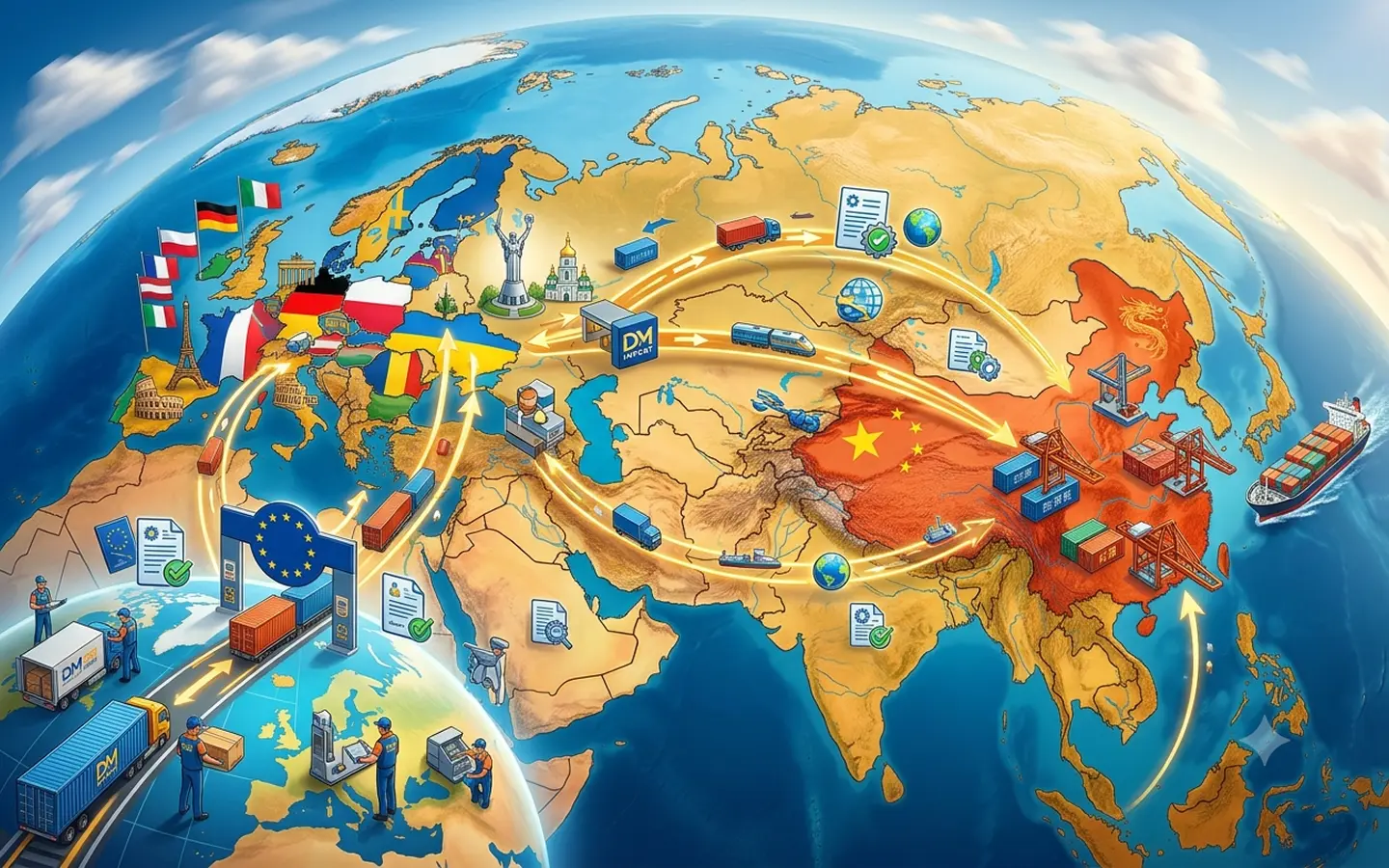
International delivery and customs clearance of goods from China: DM IMPORT works not only with Ukraine but also with EU countries.
Importing goods from China has long become an essential part of international business. Companies search for reliable manufacturers, optimize costs, and expand their sales markets. Today, DM IMPORT supports businesses not only in Ukraine but also across European Union countries, providing comprehensive assistance for international shipments.
TECHNICAL PARTNER

DM Import sincerely thanks KossaSoft company and team for their help in implementing projects. Your support is invaluable, and we are grateful for your contribution to our work.
KossaSoft is an IT company providing development and design services, from mobile applications to full-fledged platforms and CRM systems.
KossaSoft is known for its high-quality project execution, allowing our initiatives to reach new heights. Their team’s solutions and professional approach ensure reliable technical support and top-quality services. Thanks to their expertise, we can offer our users the best product with high quality and stable performance.

Development
Development of custom mobile applications that increase customer engagement.

Web Design
Creation of modern and functional websites that meet all business requirements.

UI/UX Design
User interface design that ensures intuitive and convenient usage.

Support
Providing reliable technical support and maintenance for the uninterrupted operation of your projects.